



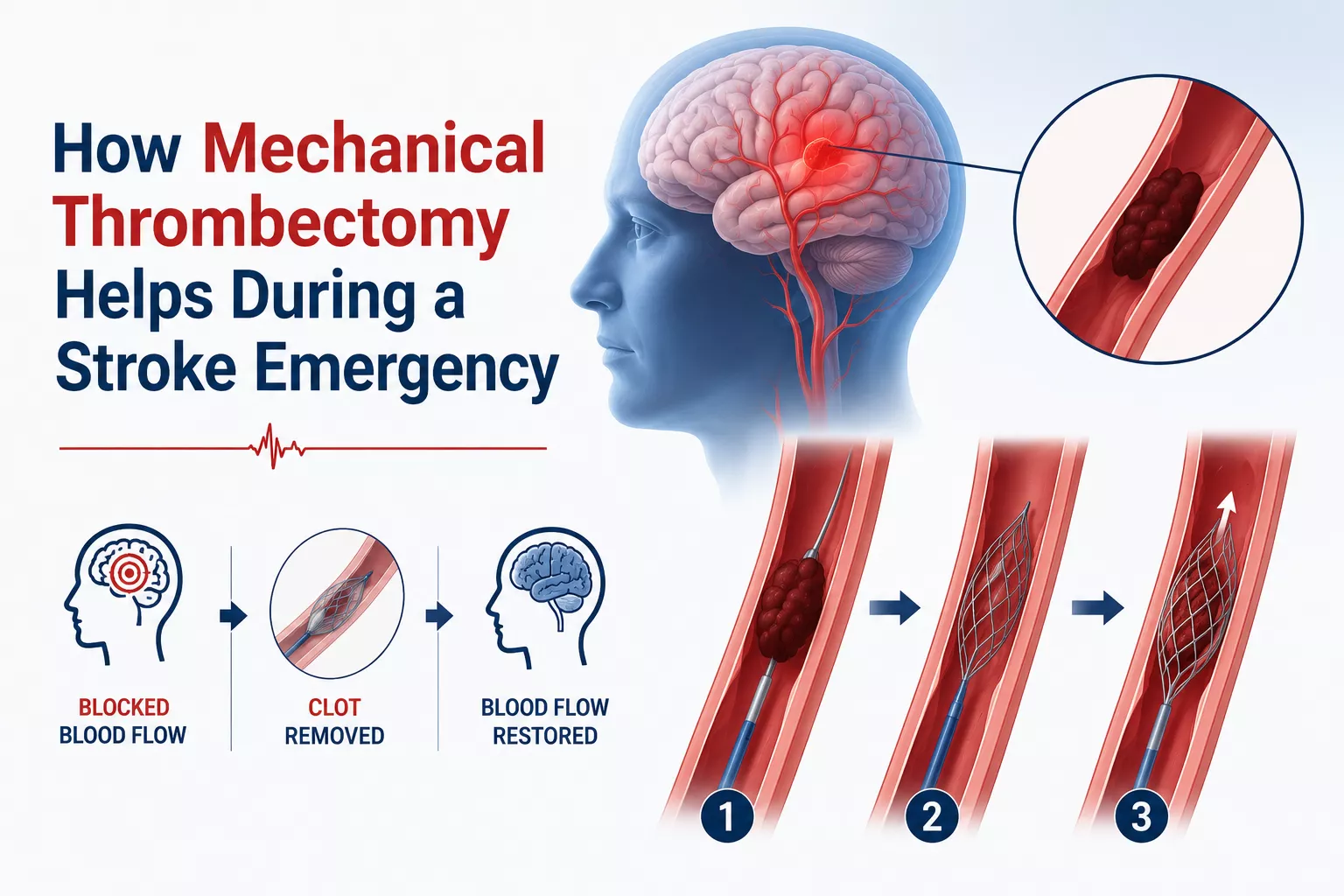
How Mechanical Thrombectomy Helps During a Stroke Emergency
It is a well known fact that uninterrupted blood flow to different parts of the body- especially the brain, heart or other major organs and organ systems is a necessity for you to function normally without any issues. When a clot forms and closes off blood supply to a region of the body, or a specific part, it can lead to a greater risk of developing an embolus, stroke or permanent tissue and organ damage, along with other long term complications. At such times, you will need mechanical thrombectomy treatment right away.
A thrombectomy is a surgical or interventional procedure done to remove a clot from any blood vessel in the body. Let us look at when you will require such a stroke clot removal procedure and how it can help you in the long term below.
What can a Thrombectomy Treat?
A thrombectomy may be recommended when you have any of the following conditions-
- If you have a pulmonary embolism.
- If you have deep vein thrombosis (DVT)
- If you have extreme limb ischemia.
- If there is acute mesenteric ischemia.
- If the renal artery is occluded or blocked.
- If you have had a heart attack.
- If you have had a stroke.
Types Of Mechanical Thrombectomy Treatment
Thrombectomies can be of two types-
- Open thrombectomy- Where a large incision is made to access the affected blood vessel, the clot is removed using a balloon and then the artery or vein is carefully repaired with sutures.
- Minimally invasive or percutaneous thrombectomy- A catheter is inserted through a small incision. Specialised instruments are then inserted into the tube or catheter to help break the clot down mechanically. Clot-busting medications may also be used here. Some of these techniques include-catheter directed thrombolysis, with or without mechanical thrombectomy or aspiration thrombectomy with a catheter or others.
Steps Involved in a Mechanical Thrombectomy Procedure
- You will first have detailed imaging done- to understand where the clot is located, its size, in the form of ultrasounds, CT or MRI scans.
- You will then be asked to either continue on certain medications or stop using them for a while- like no aspirin, while others may be continued.
- You will then be sedated – either general anaesthesia is given for open surgery, so you don’t feel too stressed during the procedure.
- The incision is made – after which a catheter is inserted via the punctured blood vessel in the arm or leg. It is moved to the part of the body where the clot is present, using real time imaging.
- A balloon is deployed to break the clot up, if it is an open thrombectomy. Specialised instruments help break down, dissolve or suck the clot out using vacuum, if a catheter approach is preferred.
- The blood vessel is repaired in an open thrombectomy or the wires and catheters are carefully removed via the initial incision. Pressure is applied, so bleeding stops, or a vascular closure device is used.
You can talk to your doctor about how to make sure the incision does not get infected, any specific after procedure instructions, which medicines need to be taken or stopped and when you can slowly return to your routine.
Risks of Thrombectomy
You may have bruising, bleeding, a pulmonary embolism, a new blood clot forming later on or may be allergic to the anaesthetic agent used.
Conclusion
Contact us at Medone Hospitals if you have any of the above symptoms or if you suffer from chronic conditions like DVT. Since stroke is a very real complication, prompt treatment within the golden hour is crucial to prevent any long lasting complications like paralysis.
Call us today!
FAQs-
Mechanical thrombectomy is a minimally invasive procedure used to remove a blood clot blocking a major artery in the brain during an ischemic stroke. A specialist guides a catheter through the blood vessels and uses a clot-retrieval device to restore blood flow to the affected area of the brain.
Mechanical thrombectomy is most effective when performed as soon as possible after stroke symptoms begin. Many patients can benefit if treatment is started within 6 hours, and selected patients may remain eligible for up to 24 hours based on advanced brain imaging and clinical evaluation.
The procedure is recommended for patients with an acute ischemic stroke caused by a large vessel blockage in the brain. Eligibility is determined using neurological assessments and imaging studies that identify the location of the clot and the amount of salvageable brain tissue.
Mechanical thrombectomy can rapidly restore blood flow, limit brain damage, reduce long-term disability, and improve the chances of functional recovery. When performed promptly in eligible patients, it significantly increases the likelihood of regaining independence after a stroke.
Yes. Many patients receive intravenous thrombolytic medication before thrombectomy if they arrive within the approved treatment window. Combining clot-busting drugs with mechanical clot removal can improve the chances of reopening blocked arteries and achieving better neurological outcomes.